
Table of Contents
- The Story of Ali and the Angel
- The Interpretation of The Story of Ali and the Angel
- 1. The Manufactured “Divine Encounter”
- In the Story:
- Modern Parallel:
- 2. The Invisible, Conveniently Unverifiable Miracle
- In the Story:
- Modern Parallel:
- 3. The Fee: Monetizing Access to the Divine
- In the Story:
- Modern Parallel:
- 4. The Fear of Public Shame
- In the Story:
- Modern Parallel:
- 5. The Power of “The King” — Social Proof and Authority Endorsement
- In the Story:
- Modern Parallel:
- 6. Mass Self-Deception: The Crowd Lies to Itself
- In the Story:
- Modern Parallel:
- 7. The Emptiness: A Coat and Slippers
- In the Story:
- Modern Parallel:
- 8. The Escalation: From Angel to “Tea Without Sugar”
- In the Story:
- Modern Parallel:
- 9. Why It Works: The Psychology of Desperation
- Why do people fall for this, over and over again?
- 10. The Real Victim: Not Ali, But the Crowd
- In the Story:
- Modern Parallel:
- 11. What Made Ali Different From Modern Clergy?
- 12. The Only Way Out: Critical Thinking
- Final Reflection
Here is the full narration of “Ali and the Angel,” just as it was told in that classic Nigerian primary school textbook .
The Story of Ali and the Angel
Once, in a land long ago, there lived a man named Ali. He was a clever trickster, who lived by his wits and had a silver tongue that could charm anyone. But Ali was also a crook, and he was always looking for a way to get rich without working for it .
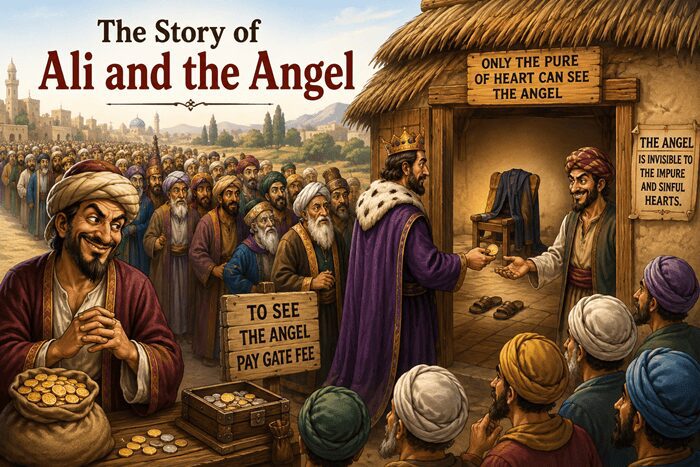
One day, Ali announced to the people that he had received a wonderful dream. He claimed that a holy angel was coming to visit him in his hut. “However,” Ali declared, “this angel is special. He will be completely invisible to anyone with an impure or sinful heart. Only the truly righteous and pure of heart will be able to see him” .
The news spread like wildfire. Soon, a great crowd gathered at Ali’s small hut, all eager to see the angel and prove their own righteousness. But Ali, ever the businessman, put a condition on this miracle: to see the angel, everyone had to pay a small gate fee .
Inside the hut, Ali set the stage for his grand deception. He had prepared a neat, empty room. In it, he placed a single wooden chair with a coat draped over the back. In front of the chair, he set a pair of slippers. To a visitor, it looked like an invisible person was sitting there .
The queue of people stretched for miles. Among them were the king, royal courtiers, religious leaders, and many others. The king went first. He paid his fee, entered the room, and saw the empty chair with the coat and slippers. He saw nothing else. “The angel must be on the seat,” he thought to himself, “but I cannot see him because I am a sinful man.” He was ashamed. When he came out, he was determined not to be humiliated. “I have seen the angel!” he declared loudly. “It is a wonderful thing to have a pure heart!” .
Watching the king, the rest of the people assumed he had indeed seen the angel. No one wanted to be the one to admit they were too sinful to see it. One after another, they paid their fee, entered the room, saw the coat and slippers, and came out proclaiming they had seen the glorious angel . Everyone was “pure of heart,” and Ali sat back and watched his bag fill with gold and silver, grinning at the magnificent lie he had convinced the entire kingdom to tell .
This story, from the New Oxford English Course, was a staple in Nigerian primary schools, especially in Lagos.
The Interpretation of The Story of Ali and the Angel
This is a masterclass in social psychology, religious manipulation, and mass deception — wrapped in a simple children’s story. Let me break it down in full, detailed commentary, connecting every element of Ali and the Angel to the tactics used by modern-day clergy and religious entrepreneurs.
1. The Manufactured “Divine Encounter”
In the Story:
Ali claimed he had a dream — a private, unverifiable revelation. He announced that an angel was coming to his hut, on his terms, at his chosen time.
Modern Parallel:
-
“God spoke to me” — the most powerful phrase in religious manipulation.
-
Private revelations, visions, prophecies, and dreams are conveniently unverifiable.
-
The clergy member positions themselves as the exclusive channel between the divine and the people.
-
You cannot question it, because you would be questioning God Himself.
Tactic: Create a monopoly on divine access. Make yourself the gatekeeper of heaven’s blessings.
2. The Invisible, Conveniently Unverifiable Miracle
In the Story:
The angel was invisible to “sinners” — a perfect excuse. No one could prove the angel wasn’t there, because admitting you couldn’t see it meant admitting you were sinful.
Modern Parallel:
-
“You couldn’t receive your healing because you lacked faith.”
-
“The miracle happened spiritually, not physically.”
-
“You didn’t see the vision because your heart is hardened.”
-
“The prophecy didn’t come true because you didn’t pray enough.”
Tactic: Shift the burden of proof onto the victim. If it doesn’t work, it’s your fault — not the clergy’s. The product is never defective; the consumer is always “unworthy.”
3. The Fee: Monetizing Access to the Divine
In the Story:
Ali charged a gate fee — a direct price for “seeing” the angel. No payment, no vision.
Modern Parallel:
-
Tithes — “You must pay God’s money first.”
-
Offerings — “Seed sowing for breakthrough.”
-
Love offerings — “Honor the man of God.”
-
Crusade tickets — “VIP seats for miracles.”
-
Special prayers — “Send N50,000 for a prophetic handkerchief.”
-
Anointing oil — “Buy this blessed oil for protection.”
Tactic: Attach a price tag to grace. Turn what should be free into a commercial transaction. Make people believe that giving money unlocks God’s power.
4. The Fear of Public Shame
In the Story:
Every person who went in saw nothing — an empty chair with a coat and slippers. But when they came out, they all lied and said they saw the angel. Why? Because admitting the truth would expose them as “sinners” in front of the entire community.
Modern Parallel:
-
In churches, people testify about miracles that didn’t happen to them.
-
They shout “I receive it!” even when they feel nothing.
-
They declare “I am healed!” while still in pain.
-
They claim “God has provided!” while their bank account is empty.
Why?
-
Fear of being judged by fellow members.
-
Fear of being labeled “faithless” or “carnal.”
-
Fear of losing status in the religious community.
-
Fear of being prayed against or excommunicated.
Tactic: Create a culture of performative faith where everyone must publicly affirm the miracle, even when privately they know nothing happened. The fear of shame silences the truth.
5. The Power of “The King” — Social Proof and Authority Endorsement
In the Story:
The king (the highest authority in the land) went first and lied. Everyone else followed. If the king believed it, it must be true, right?
Modern Parallel:
-
When politicians, celebrities, or wealthy businessmen endorse a pastor or church, it lends credibility.
-
“If the governor attends this church, it must be genuine.”
-
“If this billionaire sowed a million naira here, it must be powerful.”
-
“If the president consults this prophet, he must be real.”
But remember: powerful people can be deceived too — or they may have their own reasons (political alliances, public image, tax evasion, or even genuine need) for participating in the lie.
Tactic: Use high-profile endorsements to create the illusion of legitimacy. If the powerful believe, the masses will follow blindly.
6. Mass Self-Deception: The Crowd Lies to Itself
In the Story:
No one forced anyone to lie. Each person chose to lie to protect their reputation. Together, they created a collective delusion — a reality where the angel existed simply because everyone said it did.
Modern Parallel:
-
Congregations create an echo chamber of testimonies, prophecies, and miracles.
-
Anyone who doubts is silenced, shamed, or expelled.
-
Over time, the shared lie becomes “truth” because it is repeated often enough.
-
People begin to genuinely believe the lie because they hear it so much — a psychological phenomenon known as mass hysteria or groupthink.
Tactic: Use repetition and group pressure to replace objective reality with manufactured consensus. Make doubt feel like betrayal.
7. The Emptiness: A Coat and Slippers
In the Story:
The “angel” was just a coat draped over a chair and a pair of slippers — props. Nothing supernatural. Just cheap theater.
Modern Parallel:
-
Healing crusades where “crippled” people walk, only to be discovered later as paid actors.
-
Miracles performed with hidden magnets, threads, or pepper to simulate supernatural phenomena.
-
Prophecies that are so vague and generic they could apply to anyone (called cold reading).
-
Deliverance sessions where people convulse because of psychological suggestion, not demonic activity.
Tactic: Use stagecraft, psychology, and theatrics to create the illusion of the supernatural. The props change, but the emptiness remains.
8. The Escalation: From Angel to “Tea Without Sugar”
In the Story:
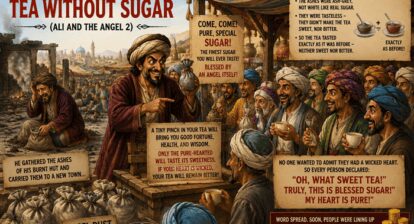
After the hut burned down, Ali repackaged the ashes as “angelic sugar” and sold it in another town. Same trick, different disguise.
Modern Parallel:
When one scam is exposed or exhausted, clergy simply rebrand:
-
From “healing oil” to “miracle water” to “anointed sand” to “blessed handkerchiefs.”
-
From “prophecy” to “dream interpretation” to “spiritual mapping.”
-
From “crusades” to “online deliverance” to “Zoom prayers.”
The product changes; the method does not.
Tactic: Adapt and innovate. When people catch on, change the packaging but keep the scam alive. There is always a new town, a new audience, or a new generation to exploit.
9. Why It Works: The Psychology of Desperation
Why do people fall for this, over and over again?
-
Desperation — People in pain will grasp at any straw.
-
Hope — The desperate want to believe. The lie gives them temporary relief.
-
Community — Churches provide belonging, and leaving means losing your tribe.
-
Fear — Fear of hell, curses, misfortune, or divine punishment keeps people compliant.
-
Sunk cost — After giving so much money and time, admitting it was a scam is too painful. So they double down.
-
Authority — Clergy are often the only educated or respected figures in poor communities. Their word is law.
Tactic: Exploit human vulnerability. Target the poor, the sick, the lonely, and the desperate. They are the most fertile ground for manipulation.
10. The Real Victim: Not Ali, But the Crowd
In the Story:
Ali walks away rich and laughing. The people walk away poorer, deceived, and still trapped in the lie they helped create.
Modern Parallel:
-
The “man of God” builds mansions, fleets of cars, private jets, and foreign bank accounts.
-
The followers remain poor, sick, and desperate — but now also guilty for not having “enough faith.”
The tragedy is not that the clergy lie. The tragedy is that the people collaborate in their own deception.
Tactic: Make the victim feel responsible for their own suffering. This prevents them from blaming the scammer and keeps them returning for more.
11. What Made Ali Different From Modern Clergy?
| Ali | Modern Clergy |
|---|---|
| Admitted he was a trickster (privately) | Believe their own lies |
| Did it for money only | Seek money, power, fame, and sexual gratification |
| Worked alone | Operate sophisticated networks |
| Scammed temporarily | Build lifelong empires |
| Had no religious cover | Use God, the Bible, and the Quran as shields |
Ali was honest about being dishonest.
Modern clergy often deceive themselves first, making them far more dangerous.
12. The Only Way Out: Critical Thinking
The story ends not with Ali being caught, but with the people still believing.
The only defense against this kind of manipulation is:
-
Education — Learning to ask questions.
-
Critical thinking — Distinguishing between evidence and assertion.
-
Emotional intelligence — Recognizing when fear or hope is driving your decisions.
-
Community accountability — Having people who will tell you the truth, not just what you want to hear.
The angel will always appear — as long as people are afraid to say, “I see nothing.”
Final Reflection
Ali and the Angel is not just a children’s story.
It is a prophetic warning — written decades ago — about what would become of religion when it abandoned truth for profit.
Today, the angels have become prophecies, healings, miracles, and deliverances.
The hut has become a cathedral, a television station, or a YouTube channel.
The gate fee has become tithes, offerings, and seed sowing.
And the crowd?
The crowd is still there, lining up, paying, and swearing they see the angel — because the alternative (admitting they see nothing) is too shameful to bear.
That, my friend, is the genius of Ali.
He didn’t create the lie. He simply gave people permission to lie to themselves — and charged them for the privilege.
And that is exactly what happens in many religious spaces today. 🙏🏾💸
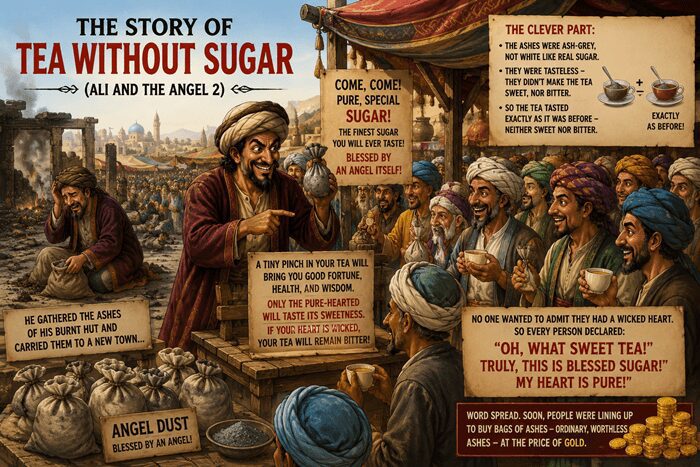
THE ASHES OF ANGELS — How a Tale of Tasteless Tea Exposes the Multi-Billion Naira Industry of Religious Deception
THE ASHES OF ANGELS — A Tale of Repackaged Decepti...
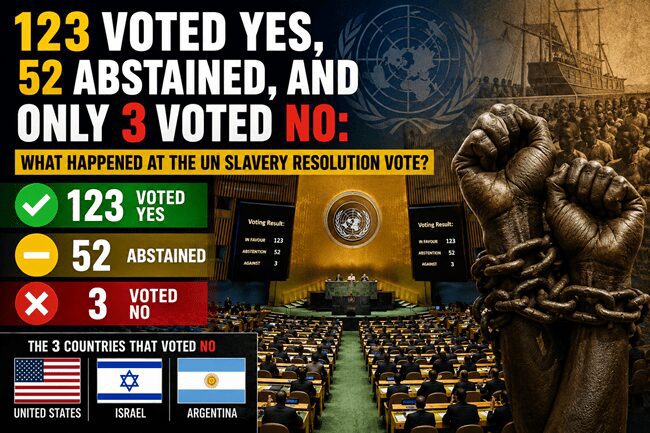
123 Voted YES, 52 Abstained, and Only 3 Voted NO: What Happened at the UN Slavery Resolution Vote?
On 25 March 2026, the United Nations General Assem...
The Price of Greed: A Story About Life, Consequences and the Value of Saving a Human Being
There are moments in life when a person is given a...

Why joining a private social network feels safer than public Facebook groups
Joining a private social network feels safer than ...

BABA DOS NOIBI ( THE WALIY OF OUR TIME) AND THE BEST MUSLIM I EVER MET Ishaq Kunle Sanni
BABA DOS NOIBI ( THE WALIY OF OUR TIME) AND THE BE...

The Certificate Deception: Why Your Degree May Not Feed You If You Cannot Fix Anything
Let me tell you a story that is playing out in alm...