

Table of Contents
- Your kindness can be exploited. Stay alert.
- ⚠️ WHERE THE REAL DANGER LIES
- 🎭 WHY SOCIAL ENGINEERING WORKS
- 🔐 WHAT ABOUT YOUR FACE, VOICE AND FINGERPRINT?
- 💳 YOUR BIGGEST IMMEDIATE RISK MAY BE YOUR FINANCIAL INFORMATION
- NEVER GIVE YOUR OTP, PIN, PASSWORD OR CARD DETAILS TO A STRANGER.
- 📱 WHAT SHOULD YOU DO IF SOMEONE GENUINELY NEEDS HELP?
- 🚨 IF YOU HAVE ALREADY INTERACTED WITH A SUSPICIOUS PERSON
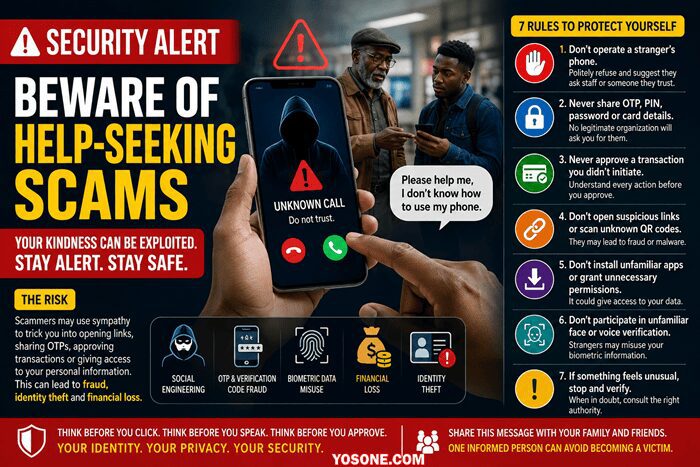
- 🛡️ REMEMBER THESE 7 RULES
- ❤️ KINDNESS AND CAUTION CAN EXIST TOGETHER
- One informed person can avoid becoming a victim.
Your kindness can be exploited. Stay alert.
Scammers are constantly developing new ways to manipulate people. One particularly concerning approach is social engineering—where criminals use deception, urgency, sympathy or politeness to persuade someone to do something that puts their money, identity or personal information at risk.
One tactic to be aware of is the “help-seeking” scam.
You may be approached in a shopping centre, marketplace, transport station, ATM area or other public place by someone who appears to need assistance with their phone.
They might say:
“Please help me. I don’t know how to use this phone.”
“I accidentally pressed something. Can you help me?”
“I need to check my account.”
“Please help me make a video call.”
“I don’t understand this application.”
The person may appear genuine, elderly, confused or distressed.
The fact that someone asks for help does NOT mean they are a scammer. However, you should be careful about what you do with a stranger’s device.
⚠️ WHERE THE REAL DANGER LIES
The danger is not that someone can magically steal your identity simply because you touched their phone.
The real risk is that you may unknowingly be persuaded to perform an action that benefits a fraudster.
For example, you could be tricked into:
- Opening a suspicious website or application.
- Clicking a malicious link.
- Scanning a QR code.
- Entering your phone number, email address or other personal information.
- Reading an OTP or verification code aloud.
- Approving a transaction.
- Authorising a payment.
- Installing an unfamiliar application.
- Granting an application unnecessary permissions.
- Allowing remote access to a device.
- Taking part in an unfamiliar face or voice verification process.
- Providing information that can later be combined with other stolen information to impersonate you.
🎭 WHY SOCIAL ENGINEERING WORKS
Scammers do not always begin by asking for money.
They may first create a situation in which you feel sorry for them, trust them or feel uncomfortable refusing to help.
Once they have gained your cooperation, they gradually introduce requests that may expose your personal information or give them access to financial services.
This is why these scams can be particularly effective against people who are simply trying to be helpful.
🔐 WHAT ABOUT YOUR FACE, VOICE AND FINGERPRINT?
Biometric information—including facial characteristics, fingerprints and voice characteristics—is sensitive personal information and should be protected.
However, it is important to understand the facts.
Simply touching somebody else’s phone does not automatically give a criminal a copy of your fingerprint.
Likewise, merely looking at a phone screen does not automatically allow someone to obtain a complete biometric identity profile of you.
Modern technology can, however, make the misuse of photographs, recordings, voice samples and other personal information a genuine concern. Criminals can combine information obtained from different sources to attempt impersonation or identity fraud.
For this reason, never participate in an unfamiliar identity-verification process simply because a stranger asks you to.
If someone asks you to look into a camera, read words aloud, record your voice, enter personal information or complete a facial-verification process, find out exactly what the process is and who operates it before proceeding.
💳 YOUR BIGGEST IMMEDIATE RISK MAY BE YOUR FINANCIAL INFORMATION
One of the most important things to remember is:
NEVER GIVE YOUR OTP, PIN, PASSWORD OR CARD DETAILS TO A STRANGER.
Your bank or financial institution will not need you to disclose your confidential PIN or OTP to another person so that they can “help” you.
Never read a verification code aloud because somebody claims it is necessary to complete a transaction.
Never approve a transaction on your phone merely because another person tells you:
“Just press this button.”
Stop and find out exactly what you are authorising.
📱 WHAT SHOULD YOU DO IF SOMEONE GENUINELY NEEDS HELP?
You don’t have to ignore someone who appears to need assistance.
Instead of taking control of their phone, consider safer alternatives.
You can say:
“I’m sorry, but I don’t feel comfortable operating your phone. Please ask a member of staff or someone you trust to help you.”
In a bank, hospital, shopping centre, airport, railway station or other organised location, direct the person to an employee or security officer.
If the person claims to be experiencing an emergency, contact the appropriate emergency service or responsible authority rather than allowing a stranger to use your phone or access your personal information.
🚨 IF YOU HAVE ALREADY INTERACTED WITH A SUSPICIOUS PERSON
Don’t panic.
If you only briefly touched someone’s phone or helped them navigate a harmless function, that does not mean your identity has automatically been stolen.
However, if you:
- Entered your password or PIN,
- Revealed an OTP,
- Approved a payment,
- Installed an unfamiliar application,
- Granted remote access,
- Shared sensitive personal information,
- Completed an unfamiliar identity-verification process, or
- Noticed suspicious activity afterwards,
take action immediately.
Contact your bank or financial institution through its official customer-service channel, change compromised passwords, revoke suspicious permissions or remote-access sessions, and report suspected fraud to the appropriate authorities.
🛡️ REMEMBER THESE 7 RULES
1. Be careful when strangers ask you to operate their phone.
2. Never disclose your OTP, PIN, password or security answers.
3. Never approve a transaction you did not personally initiate and understand.
4. Don’t scan unknown QR codes or open suspicious links.
5. Don’t install unfamiliar applications or grant unnecessary permissions.
6. Don’t participate in an unfamiliar face, voice or identity-verification process.
7. If something feels unusual, stop and verify before proceeding.
❤️ KINDNESS AND CAUTION CAN EXIST TOGETHER
Being cautious does not mean refusing to help people.
It means helping without unnecessarily exposing yourself to fraud.
A genuine person who needs assistance should understand when you choose to involve a staff member, security officer, trusted relative or appropriate authority.
Your kindness is valuable.
So are your identity, privacy and financial security.
⚠️ Think before you click.
Think before you speak.
Think before you approve.
And never surrender your confidential information simply because someone asks politely.
Share this message with your family and friends—especially elderly people and young people who may be less familiar with digital scams.
One informed person can avoid becoming a victim.

Why joining a private social network feels safer than public Facebook groups
Joining a private social network feels safer than ...
The Ultimate Guide to Meaningful Online Interaction Without Likes War
Do you feel tired after scrolling social media for...

THE ASHES OF ANGELS — How a Tale of Tasteless Tea Exposes the Multi-Billion Naira Industry of Religious Deception
THE ASHES OF ANGELS — A Tale of Repackaged Decepti...
How to Find Real Friends Online Without Endless Scrolling and Ads
Finding real friends online feels hard today. You ...

Pineapple Hot Water Does NOT Cure Cancer: Fact-Checking a Dangerous Viral Claim
Introduction Health misinformation can spread rem...