
Yosone – Find Your People. Own Your Space. Earn Badges › Forums › General Discussion › Life Experiences › The Weight of Empire: When Idi Amin Made Britain Carry Its Own Burden
Tagged: African history, British Empire, British foreign policy, colonialism, decolonization, Idi Amin, imperial hypocrisy, Milton Obote, political theatre, postcolonialism, Rudyard Kipling, Sandhurst, state violence, Uganda, White Man's Burden
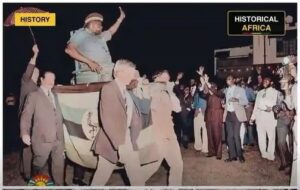
In 1977, nineteen British men carried Idi Amin on their shoulders for eleven and a half miles. He called the performance The White Man’s Burden.
This was not practicality. It was theatre. At two hundred and fifty-eight pounds, Amin was a giant, and he chose his bearers carefully—not Ugandan soldiers, not African servants, but British nationals. White men. Passport-holders of the empire that had drawn Uganda’s borders, stolen its land, and installed its kings. He turned a colonial fantasy into literal sweat.

The reference was deliberate. In 1899, Rudyard Kipling wrote his famous poem, urging the white race to take up the “burden” of civilising the dark continents through conquest and paternal cruelty. For eighty years, Britain had used those words to justify carrying rifles into Africa, carrying whips onto plantations, carrying the corpses of every nation that resisted. Amin read the poem and understood it differently. If the white man was born to carry the burden, then let him carry it. Let him carry the African. Let his back ache. Let his knees buckle. Let him learn what the weight actually feels like.
The event unfolded during the government’s annual budget presentation. Amin confirmed it himself in a live broadcast from Uganda, speaking with the calm of a man who knew exactly what image he was crafting. “I think you have heard,” he said on state radio, “I was being carried at two hundred and fifty-eight pounds by nineteen people who managed to carry me eleven and a half miles, and they were very tired.” He wanted the world to hear. He wanted London to hear that its sons had become his litter bearers.
But this was not the first performance. In 1974, four British businessmen had carried Amin through the streets on a sedan chair for an installation he explicitly named The White Man’s Burden. He sat on a throne while they strained beneath him. The cameras rolled. The message was unmistakable: the empire that had built its wealth on African backs was now carrying the African on its own shoulders—literally, publicly, for the amusement of the people it had once ruled.
None of this erases what Amin was. He was a butcher. Between one hundred thousand and five hundred thousand Ugandans died under his reign. The Nile choked with bodies. The State Research Bureau turned torture into an industry. He destroyed Uganda’s economy, expelled its professional class, and fed his paranoia with the blood of his own people. No amount of anti-imperial theatre can wash that stain. Accountability does not bend for symbolism.
Yet the symbol itself was perfect. Britain had created Amin. They trained him at Sandhurst. They armed his army. They backed his 1971 coup because Milton Obote was threatening British business interests. While Amin slaughtered Ugandans, London called him a stabilizing force. While he tortured political prisoners, British companies sold him weapons. The British establishment was willing to tolerate genocide. They were not willing to tolerate humiliation. The moment Amin made white men carry him like a conquered chief, the romance ended. The general became a madman. The strongman became a buffoon. Not because he had changed, but because he had reversed the posture.
That is the hypocrisy the image exposes. You can kill Africans and still be invited to tea at the embassy. You can starve a nation and still receive development awards. But you cannot make the white man kneel. You cannot make the empire serve. That is the unforgivable sin. Not the mass graves. The bad manners.
Amin understood this. He was no genius, but he was a master of insult. He grasped that colonial power rests on a performance of superiority—the white man must always appear to be lifting the African up, even when he is pushing him down. Amin removed the pretence. He placed himself on top and made the colonizer do the lifting. For eleven and a half miles, the script was flipped. The burden was real. The backs were sore. The cameras recorded every step.
The British men who carried him were not slaves. They were likely businessmen, diplomats, or hostages to his spectacle—compelled by the reality of dealing with a man who held the guns and the microphone. But in that image, they became what their empire had always claimed to be: the carriers of civilisation. Only now, civilisation weighed two hundred and fifty-eight pounds and was laughing at them.
Amin died in exile, unrepentant, protected by Saudi Arabia, never facing a Ugandan court. The nineteen Britons went home and told their stories, and Britain quietly forgot that it had ever called him a friend. But the photograph, the broadcast, the memory of that walk, endures. It is a reminder that colonialism is a posture as much as a system. And when the posture breaks—when the African refuses to be the burden and becomes the weight—the empire has no script left to read.