
Table of Contents
- A historic resolution led by Ghana
- What exactly did the resolution call for?
- But is the resolution legally binding?
- Why did the United States vote NO?
- Why did Israel vote NO?
- Why did Argentina vote NO?
- What about the 52 countries that abstained?
- Why does the word “gravest” matter?
- Why are reparations being discussed now?
- Reparations do not necessarily mean cash
- The question of African responsibility
- What does this vote mean for Africa?
- But Africa must also ask difficult questions
- What does the vote mean for the descendants of enslaved Africans?
- The vote was historic—but it was only a beginning
- What should happen next?
- Final reflection
On 25 March 2026, the United Nations General Assembly took a vote that immediately attracted international attention. The subject was one of the darkest chapters in human history: the trafficking and enslavement of Africans and the legacy that slavery left behind.
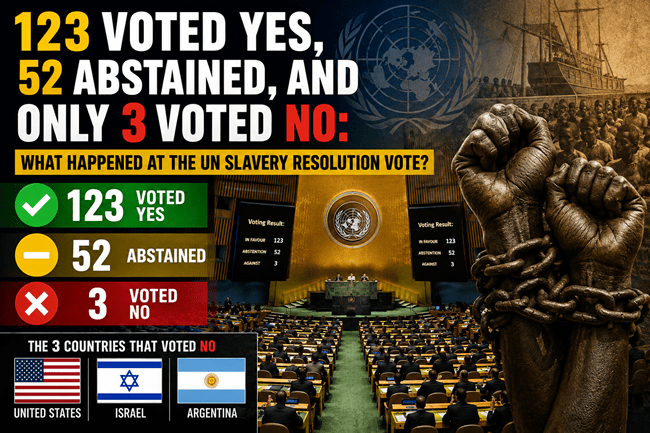
The final result was striking:
123 countries voted YES.
52 countries abstained.
3 countries voted NO — Argentina, Israel and the United States.
The resolution, introduced by Ghana, declared the trafficking of enslaved Africans and the racialized chattel enslavement of Africans to be “the gravest crime against humanity.” It also called for discussions on reparatory justice and encouraged measures such as formal apologies, restitution, compensation, rehabilitation, institutional reforms and the return of cultural heritage to countries and communities of origin.
Before going further, however, there is an important correction to the headline sometimes circulating on social media.
It was not 23 countries that voted YES. It was 123.
That distinction matters enormously. The United Nations has 193 member states, so the resolution received an overwhelming majority of those participating in the vote.
But what exactly did the United Nations vote on? Why did three countries oppose it? Why did 52 abstain? And does the resolution mean that countries will now be required to pay reparations for slavery?
The answers are more complicated than a simple list of YES and NO votes.

A historic resolution led by Ghana
The resolution was spearheaded by Ghana, an African country whose history is deeply connected to the transatlantic slave trade.
Its timing was also significant. The vote took place on the International Day of Remembrance of the Victims of Slavery and the Transatlantic Slave Trade.
The resolution was formally titled the “Declaration of the Trafficking of Enslaved Africans and Racialized Chattel Enslavement of Africans as the Gravest Crime against Humanity.” It was adopted as UN General Assembly resolution A/RES/80/250.
The resolution did not merely condemn slavery as something unpleasant that happened in the distant past.
It attempted to place the transatlantic trafficking and racialized enslavement of Africans within a broader historical, legal and moral framework.
Its argument was essentially that the scale, duration, systemic nature, brutality and continuing consequences of this history make it deserving of particular recognition.
That language is important because slavery was not simply a series of isolated acts of individual cruelty.
It developed into an enormous international system involving governments, merchants, financiers, shipping interests, plantation economies, laws, military power and commercial networks.
Millions of African men, women and children were forcibly removed from their homes and communities.
They were separated from families.
They were transported across the Atlantic under horrific conditions.
Many died during capture, forced marches, imprisonment or the Middle Passage.
Those who survived could be sold, inherited, punished, exploited and deprived of fundamental freedoms.
The economic consequences were enormous, while the human consequences were immeasurable.
What exactly did the resolution call for?
One of the most important aspects of the resolution is that it moved beyond historical remembrance.
It encouraged discussions about reparatory justice.
That phrase can easily be misunderstood.
Reparations do not necessarily mean simply writing a cheque to every descendant of an enslaved person.
The resolution refers to a range of possible measures, including:
- formal apologies;
- restitution;
- compensation;
- rehabilitation;
- satisfaction;
- guarantees of non-repetition;
- institutional and legal reforms;
- measures addressing racism and systemic discrimination.
It also called attention to cultural heritage.
The resolution urged the prompt and unhindered restitution of cultural items—including artworks, monuments, museum objects, documents and national archives—to countries and communities of origin.
This is particularly significant because slavery and colonialism did not involve only the movement of human beings.
Cultural objects were also removed from African societies and placed in museums and private collections elsewhere.
So the debate over reparations is broader than money.
It can involve land, education, historical recognition, cultural restitution, development, institutional reform, political inclusion and the preservation of historical memory.
But is the resolution legally binding?
No.
This is one of the most important facts to understand.
A UN General Assembly resolution is fundamentally different from a binding decision of the UN Security Council.
The March 25 resolution does not automatically order the United States, Britain, France, Spain, Portugal or any other country to pay a specified amount of money to African governments or descendants of enslaved Africans.
It does not create an international reparations bill that countries must immediately pay.
Instead, it establishes an important political and moral position within the United Nations and encourages further discussion and action.
The Associated Press described the resolution as symbolic but significant, noting that General Assembly resolutions are not legally binding while still reflecting international opinion and potentially influencing future discussions.
That distinction is crucial.
A person can therefore reasonably celebrate the resolution as a historic diplomatic achievement without claiming that the UN has already ordered Western governments to pay reparations.
Why did the United States vote NO?
The American position is perhaps the aspect that generated the greatest controversy.
The United States did not argue that slavery was acceptable.
In fact, the U.S. representative explicitly stated that the United States condemns the transatlantic slave trade and slavery.
The disagreement concerned the legal and political implications of the resolution.
U.S. Deputy Ambassador Dan Negrea argued that the United States does not recognize a legal right to reparations for historical acts that were not prohibited under international law at the time they occurred.
In other words, Washington objected to applying contemporary international legal standards retrospectively to historical conduct.
The United States also objected to the description of slavery as the “gravest” crime against humanity.
The American argument was that establishing a hierarchy among crimes against humanity could imply that some victims suffered from crimes that were somehow less serious than others.
That objection was echoed in different forms by European representatives.
The European Union expressed concerns about the use of superlatives and what it viewed as potentially problematic historical and legal interpretations, particularly regarding retroactive application of international law and reparations.
This is an important distinction.
Voting NO on the resolution does not automatically mean:
“We support slavery.”
The U.S. government explicitly rejects slavery.
Rather, its vote meant that it rejected the resolution as drafted, particularly aspects concerning reparations and the legal characterization of historical wrongdoing.
That distinction should be preserved if the subject is to be discussed honestly.
Why did Israel vote NO?
Israel was another of the three countries voting against the resolution.
The vote has attracted considerable attention because of Israel’s complicated history and its own debates over historical atrocities, persecution and international law.
However, it is important not to attribute a specific motive to Israel without an authoritative explanation of its vote.
The available reporting establishes the fact that Israel voted against the resolution, but a responsible discussion should distinguish between what a country voted for or against and speculation about why it did so.
The same principle applies to Argentina.
We should not turn a documented diplomatic vote into assumptions about a country’s attitude toward slavery unless that country’s representatives have clearly stated their reasoning.
Why did Argentina vote NO?
Argentina was the third country to vote against the resolution.
Again, the voting record is clear: Argentina, Israel and the United States were the only three countries voting NO.
But the significance of Argentina’s vote should not be exaggerated into a claim that Argentina was defending slavery.
A vote against a resolution can reflect disagreement with its wording, legal implications, historical framing or proposed mechanisms.
That is one of the central lessons of international diplomacy:
A vote against a resolution is not always a vote against every principle contained within it.
What about the 52 countries that abstained?
This may actually be one of the most interesting parts of the vote.
While 123 countries supported the resolution, 52 did not vote YES.
Among those abstaining were the United Kingdom and all 27 members of the European Union.
Why abstain rather than vote NO?
Abstention can serve several diplomatic purposes.
A country may agree with the general objective but disagree with certain language.
It may support recognition of historical suffering but oppose specific legal claims.
It may want to avoid openly rejecting a resolution concerning a sensitive historical subject while simultaneously avoiding endorsement of provisions it considers problematic.
That appears to have been important in this case.
European representatives expressed concerns about language concerning a hierarchy of atrocities, historical interpretation, international law and reparations.
So the voting pattern was not simply:
Africa and the Caribbean versus the West.
It was more complicated.
There was overwhelming support for the resolution, but significant disagreement about the legal and political consequences of recognizing historical slavery in this particular way.
Why does the word “gravest” matter?
At first glance, some people may wonder why governments would object to the word “gravest.”
After all, slavery was horrific.
But international law is extremely sensitive to terminology.
There have been numerous atrocities throughout human history: genocide, slavery, ethnic cleansing, torture, mass killings, crimes against humanity and other forms of systematic persecution.
When a resolution describes one historical crime as the “gravest,” some governments worry that it creates an unnecessary hierarchy of suffering.
The United States explicitly made this argument.
Supporters of the Ghanaian resolution, however, viewed the terminology differently.
Their argument was that recognizing the exceptional scale, duration, systematic nature and continuing consequences of the trafficking and enslavement of Africans does not diminish other atrocities.
Instead, it acknowledges a historical reality that they believe has not received sufficient international recognition.
This is more than a disagreement about vocabulary.
It reflects two competing approaches to historical justice.
One emphasizes universal equality among victims of atrocities.
The other emphasizes the particular historical characteristics and continuing consequences of racialized chattel slavery.
Why are reparations being discussed now?
The debate over reparations did not begin in 2026.
African, Caribbean and Black communities around the world have been discussing reparatory justice for decades.
The argument is straightforward:
If slavery generated enormous wealth for individuals, companies, governments and societies, while simultaneously destroying families, communities and economic opportunities among enslaved populations, should the consequences simply be considered closed because slavery eventually ended?
Supporters of reparations argue that the answer should be no.
They point to continuing disparities in wealth, education, land ownership, political power and economic opportunity.
They argue that historical exploitation can create conditions that persist for generations.
Opponents or skeptics respond that centuries have passed, modern populations are not identical to historical populations, responsibility is difficult to assign, and contemporary legal systems cannot easily impose liability for conduct that was lawful under the standards of its time.
These are serious questions.
And they cannot be resolved by slogans.
Reparations do not necessarily mean cash
One of the biggest misunderstandings surrounding this debate is the assumption that reparations must mean direct financial payments.
There are many possible forms.
A country could issue a formal apology.
A museum could return stolen cultural property.
An institution could establish educational programs.
Governments could invest in communities disproportionately affected by historical discrimination.
Universities could establish scholarships.
Archives could be opened.
Historical records could be digitized and made accessible to descendant communities.
Museums could identify and return objects acquired through coercion or colonial exploitation.
Governments could reform institutions that continue to produce discriminatory outcomes.
Financial compensation is one possible form of reparative justice, but it is not the only one.
Indeed, the UN resolution itself refers to several different forms of reparatory measures.
The question of African responsibility
There is another difficult issue that should not be ignored.
Discussions about the transatlantic slave trade sometimes present the history as though Europeans were the only actors involved.
The actual history was more complicated.
European powers built and expanded the transatlantic system, transported enslaved Africans across the Atlantic and operated plantation economies that depended heavily upon forced labor.
But African political authorities, merchants and intermediaries also participated in different parts of the slave-trading system.
That does not erase European responsibility for the enormous transatlantic system that developed.
Nor does it justify slavery.
Instead, it reminds us that serious historical education must resist simplistic narratives.
If the purpose of reparative justice is truth, then the truth must include the uncomfortable parts.
Africa’s history should not be reduced to the role of helpless victim, just as Europe and the Americas should not be reduced to caricatures of uncomplicated villains.
History is usually more complicated—and often more disturbing—than political slogans allow.
What does this vote mean for Africa?
For many Africans, the significance of the resolution is primarily moral.
For centuries, the suffering associated with the transatlantic slave trade was often discussed as an economic or historical phenomenon.
But behind the numbers were human beings.
A person was captured.
A family member disappeared.
A village was attacked.
A child was separated from a parent.
A community lost members of its population.
Someone was transported thousands of kilometres against his or her will.
Someone else was forced to work without freedom.
The resolution therefore represents, for many supporters, an international acknowledgment that these were not merely unfortunate events in economic history.
They were crimes against human dignity.
Ghana’s leadership is particularly significant because the country has increasingly positioned itself as a centre for conversations connecting Africa and the African diaspora.
The Ghanaian government has described the resolution as a landmark step toward reparatory justice and intends to build on the vote through further international discussions.
But Africa must also ask difficult questions
There is an important danger in discussing reparations only in terms of what Europe or America should do.
African governments themselves must also ask:
What will we do with whatever recognition, restitution, investment or resources eventually come?
Will they reach ordinary Africans?
Will they strengthen education?
Will they improve historical research?
Will museums preserve African heritage properly?
Will stolen cultural objects returned to Africa actually be accessible to the public?
Will governments use international recognition to strengthen institutions?
Or will the discussion become another political slogan while ordinary Africans continue to struggle with poverty, corruption, unemployment and poor governance?
Reparative justice should not become an excuse for African governments to avoid responsibility for problems they can solve themselves.
The historical crimes of slavery do not absolve present-day leaders of their obligations to their citizens.
What does the vote mean for the descendants of enslaved Africans?
For descendants of enslaved Africans across the Americas, the Caribbean, Europe and elsewhere, the resolution may carry a powerful symbolic meaning.
It says that the international community is prepared to discuss the consequences of slavery rather than simply commemorate its abolition.
But symbolism alone is not enough.
The difficult work begins after the vote.
What constitutes a fair reparative program?
Who qualifies?
Who pays?
Who receives?
How should responsibility be distributed?
Should reparations go to individuals, communities, governments or institutions?
How should cultural property be identified?
What happens when ownership is disputed?
How should the economic consequences of slavery be measured?
These questions have no simple answers.
The vote was historic—but it was only a beginning
The March 25 vote should neither be dismissed as meaningless nor exaggerated into something it is not.
It was not a legally enforceable global reparations order.
It did not force governments to transfer billions of dollars.
It did not settle the historical debate.
It did not establish a universally accepted formula for calculating reparations.
But it did something significant.
It placed the question of slavery, its historical consequences and reparatory justice firmly on the international diplomatic agenda.
And the numbers themselves tell a powerful story:
123 YES.
52 ABSTENTIONS.
3 NO.
The three countries that voted against the resolution were Argentina, Israel and the United States. The United Kingdom and all 27 EU member states were among those that abstained.
The overwhelming YES vote demonstrates that a large majority of the international community was willing to endorse the resolution.
The abstentions demonstrate that significant disagreement remains, particularly over legal responsibility and reparations.
The three NO votes demonstrate that some governments were unwilling to endorse the resolution in its adopted form.
All three elements matter.
What should happen next?
The most productive response to this historic vote should not be anger alone.
It should be education, research, dialogue and action.
African countries should strengthen the teaching of African history.
Schools should teach the slave trade honestly and comprehensively.
Museums should investigate the origins of their collections.
Governments should document cultural heritage that was removed from African societies.
Universities should support serious research into the economic and social consequences of slavery.
The African diaspora should be included in conversations about heritage and historical memory.
Former slave-trading and colonial powers should continue examining their historical records and considering appropriate forms of acknowledgment and restitution.
And African governments should examine their own historical roles without fear or defensiveness.
The objective should not be to manufacture permanent guilt.
The objective should be to establish truth.
Because societies cannot repair what they refuse to acknowledge.
Final reflection
The most important question arising from the UN vote may not actually be:
“Why did three countries vote NO?”
A deeper question is:
What does the world intend to do with the truth it has now formally acknowledged?
If slavery was one of the greatest crimes in human history, what responsibility does that recognition create?
If its consequences still influence societies today, how should those consequences be addressed?
If cultural objects were taken from African communities, should they remain in foreign museums indefinitely?
If historical injustice contributed to present-day inequality, what forms of corrective action are reasonable?
And if reparations are discussed, should they be limited to financial compensation—or should the conversation include education, cultural restitution, institutional reform, development and genuine reconciliation?
There is also a question for Africa itself:
If the world eventually opens the door to reparatory justice, will African governments be prepared to ensure that the benefits reach the people whose ancestors suffered—or will political elites capture another opportunity intended for ordinary Africans?
The United Nations vote has not answered these questions.
Perhaps that is precisely why it matters.
It has opened the door.
Now comes the harder part: deciding what should walk through it.
History is not merely about what happened yesterday.
It is also about understanding how yesterday helped shape today—and deciding what kind of tomorrow we want to build.
123 countries said YES.
52 abstained.
3 said NO.
But the real debate has only just begun.
The Price of Greed: A Story About Life, Consequences and the Value of Saving a Human Being
There are moments in life when a person is given a...

The Sound of Heaven: How Drums and Music Found Their Way into Church
From Silence to Celebration – The Long and Winding...