

Table of Contents
- Introduction
- What Does the Viral Message Claim?
- 1. There is no evidence that pineapple hot water cures cancer
- 2. Pineapple is a healthy fruit—but that does not make it a cancer treatment
- 3. What about bromelain?
- 4. “It kills cancer cells” is not enough to prove a cure
- 5. The claim that pineapple hot water cures “all types of cancer” is especially misleading
- 6. The claim about “alkaline water” is misleading
- 7. The alleged doctor and hospital are another major warning sign
- 8. “It does not affect healthy cells” is an unsupported claim
- 9. The claims about blood pressure and blood circulation should not be confused with cancer treatment
- FALSE ❌
- A Message to Everyone Who Receives This Post
- Verdict: FALSE ❌
Introduction
Health misinformation can spread remarkably quickly, especially when it offers a simple solution to a frightening disease such as cancer. A message circulating through WhatsApp, Facebook and other social-media platforms claims that “CANCER IS DEFEATED” and that drinking hot water containing pieces of pineapple can cure cancer.
The message appears convincing at first glance because it uses medical-sounding language, refers to an alleged professor and hospital, mentions substances such as bromelain and polyphenols, and encourages readers to forward the information to family members and friends. It even suggests that forwarding the message could save a person’s life.
But a health claim is not made true simply because it sounds scientific, is attributed to a supposed doctor, or has been forwarded thousands of times.
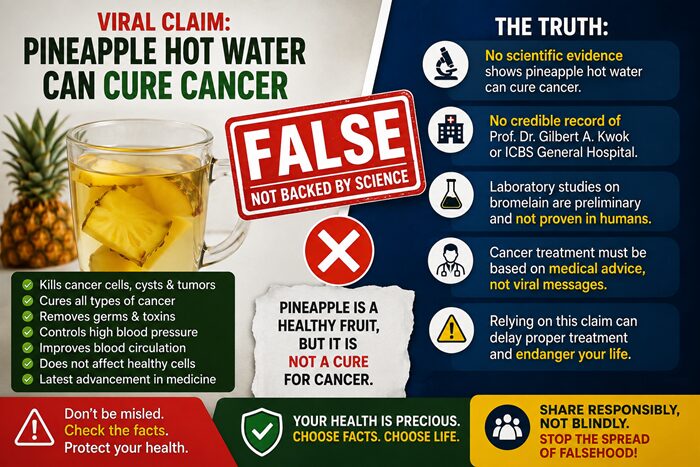
The pineapple-hot-water cancer cure claim is false. There is no credible scientific evidence that drinking pineapple mixed with hot water cures cancer, kills tumors or cysts, removes cancer cells from the human body, or treats all types of cancer.
The claim has previously been investigated by independent fact-checkers. AFP reported that there was no evidence supporting the claims and that searches found no credible record of the alleged “ICBS Hospital” or “Dr Gilbert A. Kwok.”
The National Cancer Institute (NCI) likewise states that there is no proof that any particular food, diet, vitamin, mineral, dietary supplement, herb or combination of these can slow cancer, cure it, or prevent it from returning.
This article examines the viral message, summarizes what it says, and responds to its major claims with the available evidence.
What Does the Viral Message Claim?
The message begins with the dramatic declaration:
“CANCER IS DEFEATED.”
It then presents what it calls “Pineapple hot water” as a supposed breakthrough against cancer.
According to the message, people should cut two or three pieces of pineapple into a cup and add hot water. It claims that this mixture becomes “alkaline water” and that drinking it every day provides powerful health benefits.
The message attributes the information to a person identified as “Professor Dr. Gilbert A. Kwok” of ICBS General Hospital. It claims that he urged people to distribute the information widely, supposedly because forwarding the message could save at least one person’s life.
The message then makes a series of extraordinary medical claims.
It says that hot pineapple releases “anti-cancer substances” and describes the supposed discovery as a recent advancement in medicine.
It further claims that warm pineapple can:
- Kill cancer cells.
- Kill cysts and tumors.
- Cure all types of cancer.
- Remove germs and toxins from the body.
- Deal with allergies.
- Control high blood pressure.
- Prevent blockage of blood vessels.
- Improve blood circulation.
- Reduce blood clotting.
- Destroy cancerous or “violent” cells without harming healthy cells.
The message also refers to pineapple juice, amino acids and polyphenols, presenting them as evidence for its supposed medical effects.
Finally, it ends with an emotional appeal asking readers to send the message to several groups and to encourage their relatives and friends to do the same.
In summary, the message presents a simple household drink as though it were a scientifically established treatment for cancer.
That is the central claim that must be rejected.
Fact-Checking the Claim
1. There is no evidence that pineapple hot water cures cancer
This is the most important point.
 There is no credible clinical evidence establishing pineapple hot water as a cure for cancer.
The National Cancer Institute specifically addresses claims involving foods, diets and supplements. Its conclusion is clear: there is no proof that any particular food, diet, vitamin, mineral, supplement, herb or combination can slow cancer, cure cancer, or prevent it from returning.
This does not mean that nutrition is irrelevant to people with cancer. Good nutrition is important for general health, and people undergoing cancer treatment may have specific nutritional needs.
But there is an enormous difference between saying:
“Pineapple can be part of a healthy diet.”
and saying:
“Pineapple hot water cures cancer.”
The first statement can be reasonable. The second is unsupported.
2. Pineapple is a healthy fruit—but that does not make it a cancer treatment
Pineapple contains nutrients and naturally occurring compounds. Eating fruit can be part of a balanced diet.
However, a nutritious food should not automatically be described as a medicine.
Many foods contain antioxidants, vitamins, minerals and other biologically active substances. Scientists may investigate these substances because they could potentially have useful effects.
But discovering that a substance has biological activity is only the beginning of scientific research.
Researchers must determine whether the substance works in humans, at what dose, for which disease, under what circumstances, and whether it is safe.
A food containing a potentially useful compound does not automatically become a cancer treatment.
The National Cancer Institute emphasizes that healthy eating is important, but no special food or diet has been proven to control or cure cancer.
3. What about bromelain?
One reason the viral message may sound convincing is its reference to compounds associated with pineapple, particularly bromelain.
Bromelain is a group of enzymes associated with pineapple, especially the stem.
There has been scientific research into bromelain and its possible biological effects. Some laboratory studies have produced interesting findings, including observations suggesting possible anticancer activity.
But laboratory research is not the same thing as proving a cancer treatment works in human beings.
Memorial Sloan Kettering Cancer Center explains that laboratory studies suggest bromelain may have anticancer activity, but these effects have not been studied sufficiently in humans to establish it as a cancer treatment. It specifically states that bromelain has not been shown to treat or prevent cancer.
Therefore, the existence of research into bromelain cannot legitimately be transformed into the claim:
“Drink hot pineapple water and cancer will disappear.”
That is an enormous scientific leap.
4. “It kills cancer cells” is not enough to prove a cure
This is another common problem with health misinformation.
A substance may kill certain cancer cells in a laboratory experiment. That does not automatically mean that eating the food containing that substance will kill cancer inside a human body.
Cancer is not one single disease.
There are many different types and subtypes of cancer, involving different tissues, mutations and biological processes. Treatment depends on the type and stage of cancer and other individual factors.
A substance that behaves in a particular way in a laboratory dish does not necessarily reach a tumor in the human body at an effective concentration.
It may also be broken down during digestion, absorbed differently, interact with medications, or have effects that are completely different in humans.
That is why proper clinical trials are essential.
5. The claim that pineapple hot water cures “all types of cancer” is especially misleading
The viral message does not merely claim that pineapple has some possible health benefits.
It goes much further.
It claims that pineapple hot water can cure all types of cancer.
This should immediately raise suspicion.
Cancer is an extremely broad group of diseases. Treatments vary enormously depending on whether someone has leukemia, lymphoma, breast cancer, prostate cancer, lung cancer, colorectal cancer, pancreatic cancer, brain cancer or another form of cancer.
A single cup of fruit-infused water cannot reasonably be presented as a universal cure for all these diseases without extraordinary scientific evidence.
No such evidence has been established.
The NCI states that no special food, diet, vitamin, supplement, herb or combination has been proven to slow, cure or prevent cancer from returning.
6. The claim about “alkaline water” is misleading
The viral message says that putting pineapple into hot water produces “alkaline water.”
This is another scientifically questionable part of the message.
Simply putting pieces of pineapple into hot water does not transform the drink into a proven cancer treatment.
More importantly, the concept of consuming an “alkaline” food or drink as a cure for cancer is not supported by evidence.
The body’s acid-base balance is tightly regulated by physiological systems involving the lungs, kidneys and other processes. Drinking a particular food or beverage does not simply change the body’s internal environment in a way that eliminates cancer.
The NCI specifically lists “alkaline diet” among popular dietary approaches for which there is no proof of slowing or curing cancer.
7. The alleged doctor and hospital are another major warning sign
The message attributes its claims to:
“Professor Dr. Gilbert A. Kwok” of “ICBS General Hospital.”
That attribution gives the message an appearance of authority.
However, this is not sufficient evidence.
AFP investigated the claim and reported that it found no official record of an “ICBS Hospital” in the relevant medical institution listings and no official reports about a doctor named Gilbert A. Kwok associated with the claim.
Other fact-checking investigations have also examined the same viral claim and failed to establish the existence of the alleged doctor and hospital as presented in the message.
This illustrates an important lesson:
A person’s name appearing in a viral message is not proof that the person exists, holds the stated qualifications, or made the statement attributed to them.
Before accepting a medical claim attributed to a doctor, people should look for verifiable professional records, publications, institutional affiliations and statements from recognized medical organizations.
8. “It does not affect healthy cells” is an unsupported claim
The message says that a supposed pineapple-derived medicine destroys cancer cells without affecting healthy cells.
This is an extremely important claim because selective destruction of cancer cells is a major objective of cancer research.
But the viral message provides no clinical evidence demonstrating that drinking pineapple water achieves this.
There is a huge difference between investigating whether a chemical compound has selective effects in laboratory experiments and proving that consuming a particular beverage selectively destroys cancer cells in a human being.
The message provides neither clinical trial evidence nor a recognized treatment protocol demonstrating this effect.
Therefore, the claim should not be accepted.
9. The claims about blood pressure and blood circulation should not be confused with cancer treatment
The message also claims that pineapple compounds can control high blood pressure, prevent blood-vessel blockage, improve circulation and reduce blood clotting.
Even when a food contains compounds that researchers are investigating for cardiovascular or other biological effects, this does not make the food a proven treatment for medical conditions.
Memorial Sloan Kettering notes that laboratory research has suggested possible effects of bromelain on blood clotting, but there is no clinical-trial proof that bromelain can treat circulatory disorders.
This distinction between laboratory observations and proven human treatments is essential.
People with high blood pressure, cardiovascular disease or blood-clotting problems should not replace prescribed treatment with a homemade pineapple drink.
Why This Kind of Message Can Be Dangerous
At first glance, the message may appear harmless.
After all, pineapple is a food, and drinking water is normally harmless.
But the danger lies in what a person may do because they believe the message.
Someone who has recently been diagnosed with cancer may become frightened by conventional treatment and decide that a natural remedy is safer.
Someone may delay seeing a doctor.
Someone already receiving chemotherapy, radiotherapy, surgery or another evidence-based treatment may decide to abandon it.
Someone may tell a seriously ill relative that medical treatment is unnecessary because “pineapple has defeated cancer.”
That is where misinformation becomes dangerous.
The National Cancer Institute warns that some supplements and complementary products can interact with cancer treatments and potentially affect how treatment works.
Therefore, even the general assumption that “natural means harmless” is not scientifically reliable.
What Should People Do Instead?
The responsible response to a suspected cancer remedy is not to panic, but to verify.
If you receive a message claiming that a food, herb, drink or supplement can cure cancer, ask:
- Who made the claim?
- Can the person be independently verified?
- Does the hospital or institution actually exist?
- Where are the published clinical studies?
- Were the studies performed in humans?
- Were they properly controlled?
- Has the treatment been independently replicated?
- Do recognized cancer organizations support the claim?
- Could the remedy interfere with existing treatment?
- Is the message asking you to forward it urgently to everyone you know?
That last point is particularly important.
Emotional pressure is not evidence.
The instruction “send this to five groups” or “send this to ten people so that one life can be saved” does not make a medical claim more credible.
In fact, it is often a warning sign that the message is designed to spread virally rather than to communicate carefully verified medical information.
The Correct Conclusion
Pineapple can be a healthy food.
Bromelain is a real group of enzymes associated with pineapple and has been the subject of scientific research.
Scientists may continue investigating compounds found in fruits and other foods for possible medical applications.
But none of these facts establishes the viral claim that pineapple hot water cures cancer.
The available evidence does not support the claim.
The National Cancer Institute states that no special food, diet, supplement, herb or combination has been proven to cure cancer.
Memorial Sloan Kettering likewise states that bromelain has not been shown to treat or prevent cancer.
Independent fact-checkers have investigated this particular pineapple-hot-water message and found no evidence supporting its cancer-cure claims.
Therefore, the appropriate verdict is:
FALSE ❌
Pineapple hot water has not been proven to cure cancer, kill tumors, eliminate cysts, destroy all cancer cells, or treat all types of cancer.
Pineapple may be enjoyed as part of a balanced diet, but it should not be presented as a substitute for professional cancer diagnosis or evidence-based treatment.
Most importantly, if someone has cancer, they should discuss treatment options with qualified healthcare professionals rather than relying on viral WhatsApp or social-media messages.
A Message to Everyone Who Receives This Post
We should not measure the value of health information by how many people forward it.
We should measure it by the quality of the evidence behind it.
A message can be shared by thousands of people and still be false.
A claim can sound scientific and still be completely unsupported.
A supposed professor can be named in a message without having made the statement.
And a natural food can be healthy without being a cure for a serious disease.
Before forwarding medical information, stop, verify and think.
Someone may be making an important healthcare decision based on what you share.
So instead of saying:
“Send this to ten people and save a life,”
let us say:
“Verify before you share. False health information can cost lives.”
Pineapple is food.
Pineapple is nutritious.
But pineapple hot water is not a scientifically established cure for cancer.
Choose evidence over rumours. Choose responsible sharing over viral forwarding. And when illness is involved, choose qualified medical advice over unverified internet claims.
Verdict: FALSE ❌
Fact-checking health misinformation helps protect lives.

The Price of Greed: A Story About Life, Consequences and the Value of Saving a Human Being
There are moments in life when a person is given a...

THE ASHES OF ANGELS — How a Tale of Tasteless Tea Exposes the Multi-Billion Naira Industry of Religious Deception
THE ASHES OF ANGELS — A Tale of Repackaged Decepti...

Terms of Service
Terms of Service for Yosone.com Effective Date: 0...
Find Your People. Own Your Space. Earn Badges
Welcome to a Better Kind of Social Network You ar...

123 Voted YES, 52 Abstained, and Only 3 Voted NO: What Happened at the UN Slavery Resolution Vote?
On 25 March 2026, the United Nations General Assem...
Privacy Policy
Privacy Policy for Yosone.com Effective Date: 06t...