
Table of Contents
- The Night Everything Changed
- The Bag in the Bush
- Seventeen Years of Silence
- May 6, 2019
- The Money That Never Left the Story
- The Most Dangerous Form of Greed
- The First Lesson: Human Life Is More Valuable Than Money
- The Second Lesson: Corruption Destroys the Moral Meaning of Responsibility
- The Third Lesson: Not Every Consequence Is Immediate
- The Fourth Lesson: Do Not Glorify Criminality
- The Fifth Lesson: Money Obtained Through Suffering Is Not a Blessing
- The Sixth Lesson: Save People Whenever You Can
- The Seventh Lesson: Never Let Entertainment Destroy Your Compassion
- The Eighth Lesson: We Should Fear Becoming Comfortable With Evil
- A Final Reflection
- Food for Thought
There are moments in life when a person is given a choice between doing what is right and doing what is profitable.
Sometimes the difference between the two choices appears insignificant.
Sometimes it is only a few seconds.
Sometimes it is the difference between money and compassion.
But there are moments when that seemingly small decision can change the course of many lives forever.
The story that follows is presented as a personal account reportedly shared by a retired police officer. Whether one interprets what happened as divine retribution, coincidence, fate, consequence, or simply one of life’s painful mysteries, the moral lessons are powerful.
It is a story about greed.
It is a story about corruption.
It is a story about the value of human life.
Most importantly, it is a story about why we should never allow money, politics, ideology, entertainment, or personal interest to make us indifferent to the suffering of another human being.
The Night Everything Changed
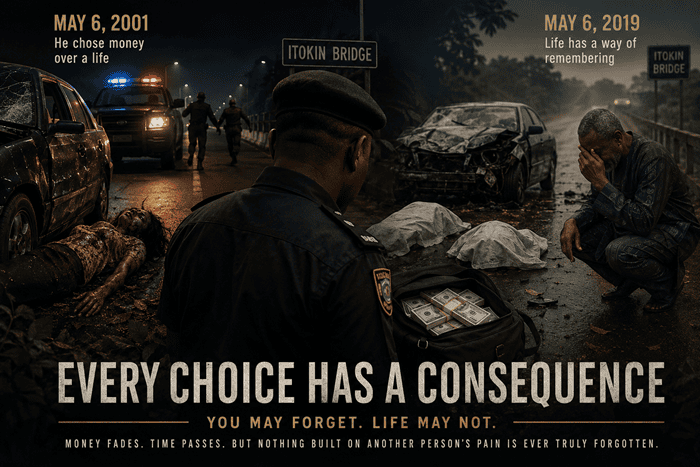
During the administration of President Olusegun Obasanjo, a police officer was posted to a station around Itokin.
At the time, the area was reportedly experiencing serious security challenges. Itokin Bridge and its surrounding roads were regarded as dangerous, particularly at night. Police officers were therefore frequently deployed around the bridge to respond to criminal activities and protect travellers.
Then came the night of May 6, 2001.
A woman who had recently returned from the United States was travelling towards Ijebu-Ode. It was already late, and the road was dark.
As she approached Itokin Bridge, armed robbers attacked her.
The attack was violent.
Her vehicle was badly damaged, and she was seriously injured.
But there was one thing the attackers did not anticipate.
Nearby police officers heard the sound of gunshots.
They immediately moved towards the scene.
The arrival of the police frightened the robbers. They abandoned the attack and fled into the darkness.
The woman had survived the initial assault.
She was badly injured, but according to the account, she was still alive.
At that moment, the situation could have ended differently.
The police could have secured the scene, placed the injured woman inside their vehicle and rushed her to the nearest appropriate medical facility.
Perhaps she would have survived.
Perhaps she would not have.
But at least she would have been given a chance.
That chance, however, was taken away.
The Bag in the Bush
The police officer leading the patrol approached the injured woman.
She was weak.
She was struggling.
But she was conscious enough to communicate.
She reportedly pointed towards a nearby bush.
The officer followed the direction of her hand.
Inside the bush was a bag.
The robbers had apparently failed to take it.
When the officer opened the bag, he discovered something that changed the entire situation.
The bag contained dollars.
A substantial amount of money.
And suddenly, the woman in front of him was no longer the most important thing in his mind.
The injured human being became secondary.
The money became primary.
This is where the tragedy became deeper than the original robbery.
The robbers had attacked the woman because they wanted her money.
But according to the officer’s later confession, greed then influenced the very person who was supposed to rescue her.
He allegedly ordered the other officers to pursue the fleeing criminals.
On the surface, it appeared to be the proper thing to do.
After all, the robbers had just committed a crime.
But, according to his later account, his real intention was to remove the other officers from the scene so that they would not discover the money.
The police vehicle that could have carried the injured woman to safety was therefore used to pursue criminals who had already disappeared into the darkness.
The woman remained behind.
In desperate need of medical attention.
And eventually, she died.
Imagine the tragedy of that moment.
She had survived the armed attack.
She had survived the gunfire.
She had survived long enough for the police to arrive.
But she allegedly did not survive the greed of the person who had the opportunity to help her.
The robbers had failed to take everything from her.
But the person who should have been her rescuer reportedly took something far more precious than money:
her chance to live.
Seventeen Years of Silence
Years passed.
The police officer eventually retired.
Life continued.
He relocated to Ijebu-Ode and lived his life.
Perhaps the memory of that night remained somewhere in his mind.
Perhaps he occasionally remembered it.
Or perhaps, as happens with many people who have committed terrible acts, he learned to bury the memory beneath the demands of everyday life.
Seventeen years is a long time.
A person can build an entirely different life in seventeen years.
Children grow up.
Careers end.
People marry.
Houses are built.
Businesses are established.
Children travel abroad.
Memories fade.
But the passage of time does not necessarily erase the moral weight of what we have done.
In April 2019, there was another kidnapping incident around Itokin Bridge.
The retired officer was present in the area and escaped unharmed.
Understandably, he was grateful.
He had survived another dangerous encounter.
He called his children who were abroad and told them that he wanted to celebrate his survival and his birthday together.
It was supposed to be a celebration of life.
A father had escaped danger.
His children were coming home.
There would be happiness.
There would be thanksgiving.
There would be celebration.
But only a few weeks later, something happened that transformed that anticipated celebration into unimaginable grief.
May 6, 2019
On May 6, 2019, exactly eighteen years after the reported incident of May 6, 2001, the officer’s two children were involved in a fatal accident close to Itokin Bridge while travelling towards Ijebu-Ode shortly after arriving in Nigeria.
They died instantly.
The father rushed to the scene.
And when he arrived, something happened that he could never have anticipated.
He recognized the place.
It was the same location.
The same area.
The same Itokin Bridge environment where, according to his account, he had once left an injured woman without the urgent medical assistance she needed.
Seventeen years earlier, he had stood at that location and made a choice.
Now he stood there again, looking at the lifeless bodies of his own children.
According to the account he later shared, the memory came flooding back.
The woman.
The bag.
The dollars.
The police vehicle.
The decision.
The greed.
The death.
Everything he had apparently buried for years suddenly returned.
And that is perhaps one of the most frightening aspects of the story.
He had moved on.
But the memory had not disappeared.
It had merely been buried.
The Money That Never Left the Story
According to the officer’s confession, the money he took from that incident was eventually used to support his children and send them abroad.
Think about the irony.
The money obtained through an act of alleged corruption and greed became part of the resources used to build the lives of the very children whose deaths later forced him to confront the memory of how the money had been acquired.
This does not prove that his children’s deaths were punishment for his actions.
No human being can confidently make such a judgment.
We do not know the unseen realities behind tragedies.
We should therefore be careful when discussing divine punishment or claiming that a particular calamity was certainly caused by a particular sin.
But we can still draw a profound moral lesson.
Wrongdoing does not become right simply because years have passed.
Money does not become clean merely because it has been spent.
A crime does not become morally insignificant because nobody confronted us about it.
And a person’s silence does not mean that his conscience has forgotten.
The story reminds us that we should never confuse escaping human accountability with escaping the moral consequences of our actions.
The Most Dangerous Form of Greed
Greed is dangerous because it rarely announces itself as evil.
A greedy person does not always wake up saying:
“Today I will destroy another person’s life.”
Sometimes greed begins with a much smaller thought:
“Nobody will know.”
“I deserve this.”
“I have suffered enough.”
“It is only money.”
“Everyone is doing it.”
“I will help myself first.”
“The person will survive.”
That is how conscience is gradually silenced.
The police officer, according to the account, had a choice.
He could have looked at the woman and seen a human being.
Instead, he looked at the situation and saw an opportunity.
That is the transformation we must fear.
The moment we stop seeing people as human beings and start seeing them merely as opportunities, statistics, political opponents, sources of money, obstacles, or entertainment, something has gone terribly wrong inside us.
The First Lesson: Human Life Is More Valuable Than Money
The most important lesson from this story is simple:
A human life is worth more than money.
No amount of dollars can compensate for the life of a human being.
No property is worth deliberately allowing someone to die.
No political interest is worth celebrating innocent suffering.
No business opportunity is worth exploiting another person’s desperation.
No personal benefit is worth becoming the reason another person loses everything.
Money can be earned again.
A vehicle can be replaced.
A house can be rebuilt.
A business can recover.
But a life cannot be restored by human beings once it is gone.
This is why every opportunity to save a life should be taken seriously.
If you can help someone without putting yourself in unreasonable danger, help.
If someone is injured, seek medical assistance.
If someone is being attacked, alert the appropriate authorities.
If someone is in distress, do not laugh at their suffering.
And if you find yourself in possession of another person’s property, remember that having access to something does not make it yours.
The Second Lesson: Corruption Destroys the Moral Meaning of Responsibility
The story also teaches us something about public service.
A uniform does not automatically make a person righteous.
A title does not make a person trustworthy.
A position of authority is a responsibility, not a license for exploitation.
When a police officer receives public authority, that authority carries an enormous moral burden.
People who are vulnerable often look to those in authority for protection.
Imagine being attacked and seeing the police arrive.
You expect relief.
You expect safety.
You expect someone to help.
If the person entrusted with protecting you instead sees your suffering as an opportunity to enrich himself, the betrayal becomes particularly painful.
This principle applies beyond the police.
It applies to doctors, teachers, judges, politicians, religious leaders, civil servants, employers, business owners, community leaders and ordinary citizens.
Whenever someone places trust in you, remember that you have been given an opportunity to serve—not an opportunity to exploit.
The Third Lesson: Not Every Consequence Is Immediate
One of the greatest temptations in wrongdoing is the illusion that there will be no consequences.
A dishonest person looks around.
Nobody caught him.
Nobody challenged him.
He made money.
He succeeded.
Years pass.
Nothing happens.
Then he concludes:
“I got away with it.”
But that conclusion can be dangerously premature.
Sometimes consequences are immediate.
Sometimes they are legal.
Sometimes they are financial.
Sometimes they destroy relationships.
Sometimes they damage a person’s reputation.
Sometimes they appear through the psychological burden of guilt.
And sometimes, in ways we cannot predict or explain, the consequences of human wrongdoing become part of a person’s life story many years later.
The lesson is not that every tragedy should automatically be interpreted as punishment.
The lesson is that we should never commit evil simply because we cannot see an immediate consequence.
The Fourth Lesson: Do Not Glorify Criminality
The story also raises an uncomfortable question about society.
What happens when criminality becomes entertainment?
What happens when people begin to celebrate criminals because the criminals are wealthy?
What happens when kidnappers become subjects of admiration?
What happens when people laugh about the suffering of victims?
What happens when people reduce the kidnapping of another human being to political arguments, online jokes, tribal sentiment or social-media “cruise”?
We must be careful.
Behind every kidnapping statistic is a human being.
Behind every ransom demand is a frightened family.
Behind every murdered victim is someone who had parents, siblings, friends, colleagues and people who loved them.
A kidnapping is not merely content for social media.
A murder is not merely a headline.
A family losing its breadwinner is not a joke.
A child losing a parent is not entertainment.
The victims are human beings.
And when society loses the ability to recognize that, society itself begins to lose its humanity.
The Fifth Lesson: Money Obtained Through Suffering Is Not a Blessing
There is a difference between wealth and blessed wealth.
A person may possess money and still live without peace.
A person may build a magnificent house with money obtained dishonestly, but a beautiful building cannot automatically create a beautiful life.
A person may send children abroad using corrupt proceeds, but money cannot guarantee their safety.
A person may accumulate enormous wealth while simultaneously accumulating enormous moral debts.
The tragedy is that people often evaluate success by what they can see.
They see the car.
They see the mansion.
They see the expensive clothes.
They see foreign trips.
They see children studying abroad.
They see influence.
But they do not see the tears behind the money.
They do not see the victims.
They do not see the conscience.
They do not see the prayers of the people who were harmed.
They do not see the moral burden carried by the person who obtained wealth through injustice.
That is why we should never envy every person who appears successful.
Some wealth carries a story that the world cannot see.
The Sixth Lesson: Save People Whenever You Can
This is perhaps the simplest message in the entire story.
It is good to save people.
If you have the opportunity to save a life, do not allow greed to distract you.
If someone is drowning and you can safely help, help.
If someone is injured, call for medical assistance.
If you witness a crime, alert the appropriate authorities.
If someone is being persecuted, do what you reasonably can.
If someone is hungry and you can feed them, feed them.
If someone is stranded and you can assist, assist them.
You may never know the full significance of a small act of kindness.
The person you help today may never be able to repay you.
That is not the point.
The value of helping someone is not measured by what they can give you in return.
Sometimes the greatest reward of an action is simply knowing that you refused to abandon another human being when you had the opportunity to help.
The Seventh Lesson: Never Let Entertainment Destroy Your Compassion
We live in an age where almost everything can become content.
People record accidents.
People livestream disasters.
People make jokes about tragedy.
People argue about victims.
People turn suffering into political ammunition.
Social media can make terrible events feel distant.
A person may watch a kidnapping story from a comfortable room and laugh.
But somewhere, a mother is awake all night.
Somewhere, a father is negotiating desperately for the release of his child.
Somewhere, a family is selling land, property or savings to raise ransom.
Somewhere, a child is asking why Daddy has not come home.
Somewhere, a widow is wondering how she will survive.
The fact that we are not experiencing their pain does not mean their pain is imaginary.
Compassion requires imagination.
We must be able to look beyond the screen and ask:
What if this were my family?
What if it were my father?
My mother?
My brother?
My sister?
My child?
Would I still find it funny?
Would I still call it “cruise”?
Would I still celebrate the people responsible?
Would I still make jokes?
Perhaps that question alone could restore some humanity to our conversations.
The Eighth Lesson: We Should Fear Becoming Comfortable With Evil
One of the greatest dangers to society is not merely the existence of criminals.
Criminals have existed throughout human history.
The deeper danger is when ordinary people become comfortable with criminality.
When evil becomes normal.
When corruption becomes expected.
When dishonesty becomes intelligence.
When stealing becomes “connection.”
When kidnapping becomes business.
When victims become objects of mockery.
When people begin asking only:
“How much money is involved?”
instead of:
“Who is being hurt?”
That is when society becomes morally sick.
A healthy society does not merely ask whether something is profitable.
It asks whether it is right.
It does not merely ask whether something is legal.
It asks whether it is just.
It does not merely ask whether someone is powerful.
It asks whether that person is responsible.
A Final Reflection
The story of the retired officer is disturbing because it presents us with a terrible possibility:
A person can make one selfish decision and then spend years living with its consequences—sometimes without even realizing how deeply the past has remained within him.
Whether one accepts the story as an example of divine retribution, coincidence, psychological guilt, or tragic circumstance, its moral warning remains.
Do not choose evil merely because you think you have gotten away with it.
Do not steal because you believe nobody is watching.
Do not exploit someone because they are weak.
Do not celebrate a criminal because he has money.
Do not mock victims because their suffering is politically inconvenient.
Do not turn another person’s tragedy into entertainment.
Do not allow greed to make you forget that the person in front of you is somebody’s beloved child, parent, spouse or sibling.
And above all, do not underestimate the value of saving a human life.
The police officer reportedly spent seventeen years believing that the terrible event was behind him.
But on that fateful day in 2019, the past suddenly stood before him.
The location remembered what he had tried to forget.
The scene brought back a decision he had made years earlier.
And whether we interpret that moment spiritually or psychologically, one truth remains:
Our actions matter.
What we do to people matters.
What we take from people matters.
What we say about people matters.
What we celebrate matters.
What we laugh about matters.
And the way we respond when another human being is in distress reveals something about who we truly are.
Perhaps the greatest tragedy in this story is not simply that a woman died.
It is that, according to the account, she was reportedly still alive when the opportunity to save her existed.
The difference between life and death may have been a vehicle ride to a hospital.
The difference may have been a few minutes.
The difference may have been one decision.
That is why we should never underestimate small choices.
A decision made in seconds can affect decades.
A moment of greed can destroy lives.
A moment of courage can save one.
A moment of compassion can become someone’s greatest reason to keep living.
So, before we ask what we can gain from another person’s misfortune, let us first ask what we can do to reduce their suffering.
Before we laugh at a victim, let us imagine their family.
Before we celebrate criminal wealth, let us remember the people whose pain may be hidden behind it.
Before we say, “It does not concern me,” let us remember that life can change unexpectedly.
Today, it may be another person’s tragedy.
Tomorrow, it could be ours.
And when that day comes, we will hope that somebody chooses compassion over greed.
Somebody chooses humanity over politics.
Somebody chooses life over money.
Somebody chooses to help.
Food for Thought
Somewhere tonight, a family may still be grieving a loved one lost to violence.
Somewhere, a father may be struggling to pay a ransom.
Somewhere, a mother may be staring at an empty chair.
Somewhere, a child may be growing up without a parent.
Somewhere, somebody may be crying silently because the person they loved never came home.
Their pain is real, even if we cannot see it.
The jokes online will eventually disappear.
The arguments will end.
The livestreams will stop.
The hashtags will fade.
The comments will be buried beneath newer posts.
But the families left behind will still have to live with the consequences.
That is why we must be careful about what we celebrate.
We must be careful about whom we glorify.
We must be careful about what we normalize.
And we must never allow money to become more valuable to us than human life.
Perhaps the greatest question this story leaves behind is not “Did the officer receive punishment?”
Perhaps the greater question is:
What kind of person are we becoming?
If we discovered a bag of money belonging to someone who was dying, would we think first about ourselves or about saving them?
If criminals became wealthy, would their wealth make us admire them?
If a victim belonged to a political group we disliked, would we still feel compassion?
If tragedy happened to somebody we disagreed with, would we still recognize their humanity?
If helping another person brought us no reward, would we still help?
And if we knew that nobody would ever discover what we had done, would we still choose to do what is right?
Those are uncomfortable questions.
But perhaps they are necessary ones.
Because morality is not truly tested when doing good is convenient.
It is tested when doing evil appears profitable.
It is tested when nobody is watching.
It is tested when we can benefit from another person’s pain.
It is tested when greed whispers:
“Take it. Nobody will know.”
At such moments, we must remember that another human being’s suffering is not an opportunity.
It is a call to compassion.
Another person’s weakness is not an invitation to exploit them.
It is an opportunity to show character.
Another person’s tragedy is not entertainment.
It is a reminder of our shared humanity.
And another person’s life is never a price worth paying for our greed.
It is good to save people.
Save a life when you can.
Help someone when you can.
Give when you can.
Speak up when you can.
Protect the vulnerable when you can.
Choose compassion when greed presents itself.
Because we may forget the good we did years ago.
We may even forget the person we helped.
But somewhere, that person may still remember that when they were at their weakest, somebody chose not to abandon them.
May we never become so obsessed with money, power, politics, tribalism or entertainment that we forget the humanity of the people around us.
And may we never make another person’s tears the foundation upon which we build our happiness.
Food for thought.
Good day, everyone.
123 Voted YES, 52 Abstained, and Only 3 Voted NO: What Happened at the UN Slavery Resolution Vote?
On 25 March 2026, the United Nations General Assem...

THE ASHES OF ANGELS — How a Tale of Tasteless Tea Exposes the Multi-Billion Naira Industry of Religious Deception
THE ASHES OF ANGELS — A Tale of Repackaged Decepti...

The Certificate Deception: Why Your Degree May Not Feed You If You Cannot Fix Anything
Let me tell you a story that is playing out in alm...

Ali and the Angel — A Tale of Deception, Fear, and the Crowd That Chose to Lie
Here is the full narration of "Ali and the Angel,"...

The Sound of Heaven: How Drums and Music Found Their Way into Church
From Silence to Celebration – The Long and Winding...